
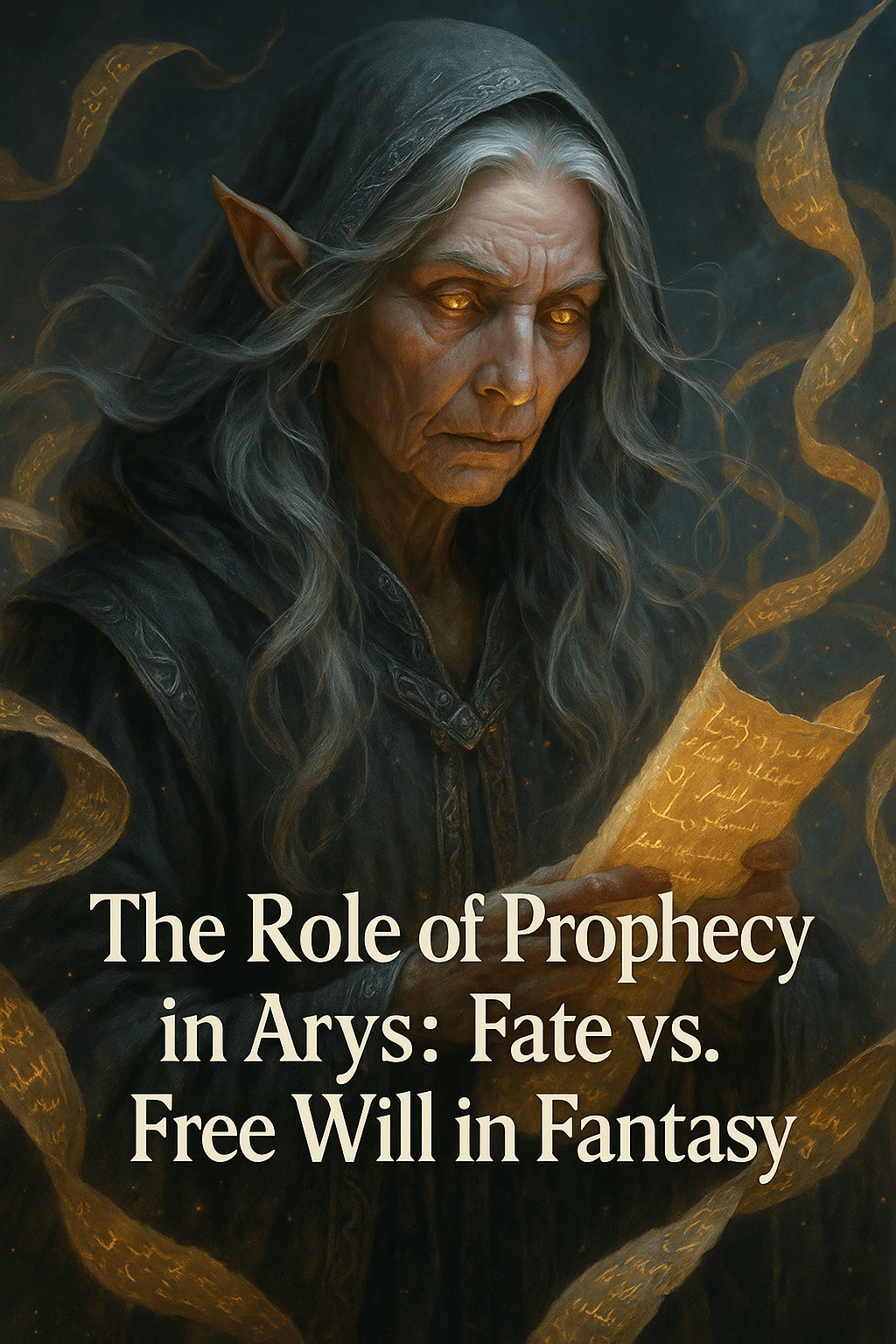
What if your destiny had already been written—etched in stars, sealed by ancient tongues, and whispered across generations? Would you fight it, follow it, or try to rewrite it?
This is the question at the heart of Arys, a New Adult fantasy novel that weaves prophecy not just as a plot device, but as a philosophical battleground between fate and free will. In a world where magic stems from divine law, and rebellion rises against a tyrant who weaponizes prophecy for power, the future isn’t just foretold—it’s contested.
Let’s explore how Arys uses prophecy to deepen world-building, drive character conflict, and challenge readers to ask: Are we bound by fate, or do we forge our own path?
What Is the Role of Prophecy in Fantasy Fiction?
Prophecy in fantasy isn’t just about predicting the future—it’s about confronting the present. Whether it’s a chosen one trope or a twisted divine message, prophecy acts as a narrative force that challenges belief, identity, and power.
Prophecy as Power: More Than a Plot Twist
In many fantasy stories, prophecy acts like a breadcrumb trail—a way to hint at what’s coming without giving away the whole loaf. But in Arys, prophecy functions more like a pressure cooker. It raises the stakes, compresses choices, and turns every character decision into a confrontation with fate.
At the center of the novel is Arys Sereniel Vālorin, the hidden heir to a fallen elven monarchy, prophesied to either bring peace or chaos to her shattered world. She’s called the Storm Queen by those who fear her, and the Daughter of the Starsby those who believe in her destiny. But prophecy in Arys isn’t a fixed outcome—it’s a mirror reflecting what others wantto believe about her.
This tension creates a narrative space where readers (and Arys herself) have to ask: Is she a chosen savior? Or a convenient symbol?
One pivotal moment captures this tension: when Arys first reads the ancient words tied to her lineage, she half expects to feel something awaken in her. Instead, all she feels is fear—and doubt. “What if they’re wrong about me?” she whispers. “Or worse… what if they’re right?”
Elborix and the Tyranny of Predestination
A compelling foil to Arys is Elborix, the tyrant who overthrew her family. Unlike many fantasy villains who scoff at prophecy, Elborix believes in it—and twists it to justify his iron rule. To him, prophecy is proof that only a singular, absolute leader can protect their people from destruction. He believes in fate. Just not the one Arys represents.
This ideological clash makes their battle not just a physical or political one, but a spiritual war over the meaning of destiny. Elborix weaponizes the fear of chaos. Arys must learn to wield the hope of change.
Prophecy in Fantasy: A Broader Tradition
Arys joins a long lineage of high fantasy stories where prophecy shapes character and conflict.
- In J.R.R. Tolkien’s The Lord of the Rings, Aragorn‘s reluctant return to the throne and Frodo’s burden as Ringbearer echo ancient predictions—but both characters must still choose their path. The prophecy guides, but it doesn’t bind.
- In Harry Potter, the “Chosen One” prophecy complicates rather than clarifies Harry’s destiny. It only becomes true because Voldemort believes in it.
- In Shadow and Bone, Alina’s power becomes a political symbol of prophecy and manipulation—just like Arys’s title as Storm Queen.
- And in The Matrix, the Oracle tells Neo, “You’ve got the gift, but it looks like you’re waiting for something.” Her kitchen bears the phrase “Know Thyself”, a nod to ancient philosophy and the idea that prophecy begins not with certainty—but with introspection.
Prophecy in fantasy isn’t about prediction. It’s about perception.
In all these stories, prophecy isn’t just a narrative device—it’s a philosophical tension point. Who interprets it? Who benefits from it? And who dares to challenge it?
A Philosophy Woven Into Magic
The magic system in Arys, known as Táravesta, is rooted in divine truth rather than brute force. It rewards those who understand and align themselves with spiritual law, not those who dominate it.
Prophecy and power go hand in hand—but in this world, power comes from alignment, not domination.
For Arys, her journey is less about fulfilling a prophecy and more about discovering whether she believes in it at all—and what it means to define herself outside of the roles others project onto her.
That’s where the tension between fate and free will becomes more than a theme. It becomes a personal reckoning.
A Tool for Writers: Why This Matters
If you’re an aspiring fantasy writer, prophecy can be one of the most powerful tools in your narrative toolbox—but only if you use it intentionally. More than just a way to foreshadow events, prophecy can create a deeply emotional and thematic core for your story.
Why Writers Love Prophecy:
- It creates internal conflict – Characters must decide who they really are.
- It adds mystery and tension – What does the prophecy really mean?
- It forces choices – Do they fulfill it? Reject it? Rewrite it?
- It mirrors real-world belief systems – Power, truth, and interpretation are constantly at odds.
- It supports worldbuilding – Prophecies add mythic depth to cultures, religions, and rebellions.
In Arys, prophecy does three things:
- Drives internal conflict – Arys doubts her worthiness and fears the prophecy may be wrong—or worse, right in the worst way. This deepens her emotional arc and connects readers to her vulnerabilities.
- Shapes the political landscape – Elborix builds propaganda around his version of the prophecy to control the masses, making prophecy not just personal but public. It becomes a weapon of influence and control.
- Forces philosophical questions – Characters (and readers) must confront the nature of destiny, belief, and self-determination. Is prophecy truth? Or is it interpretation?
Prophecy isn’t just a plot device—it’s a crucible for character development.
Many high fantasy authors use prophecy because it offers built-in narrative tension. It plants seeds of mystery and anticipation. Think of the intrigue it creates: What does the prophecy really mean? Who is the chosen one, and what if they don’t want the role? Can it be interpreted in more than one way? Should it be followed—or fought?
Prophecy also functions as a reflection of genre itself. Fantasy often explores the battle between cosmic order and chaos, between divine design and human agency. Prophecies symbolize this tension, acting as a kind of riddle where the answer is not the point—it’s the choices made along the way.
Writers love prophecy because it allows room for irony, twists, betrayal, doubt, and discovery. Done well, it becomes a living question in the story—one that evolves alongside the protagonist.
Want a closer look at how Táravesta works? Learn more about the magic system of Arys here.
Fantasy as a Mirror: Prophecy and the Real World
The power of prophecy in fiction often echoes how we engage with belief and identity in the real world. Prophecy is, at its core, a story—an idea of what might happen, shaped by who tells it, how it’s framed, and who believes in it. This mirrors how real-world political figures harness narratives to cast themselves as “chosen” saviors or predestined leaders.
Consider the rise of populist figures like Donald Trump, who cultivated a mythic persona around ideas of fate and exceptionalism. He often spoke in absolutes, suggesting that only he could fix what was broken, echoing the archetype of the prophesied hero or messiah. His followers elevated this further, treating him as a near-messianic figure, a phenomenon echoed in religious and political rhetoric across history. Like Elborix in Arys, these figures don’t just follow a prophecy—they write one around themselves and dare the world to believe in it.
Historical monarchies and dynasties have long relied on prophecy or divine right to secure and justify their rule:
- Egyptian pharaohs were seen as literal gods on Earth.
- Chinese emperors invoked the “Mandate of Heaven,” lost when disorder rose.
- Joan of Arc claimed divine visions and became a savior-figure for France.
- Elizabeth I was mythologized as the “Virgin Queen,” a divine protector of England.
These narratives were not just ceremonial—they were political. They unified nations, suppressed dissent, and created lasting legacies. Just like in fantasy, prophecy in history shaped the perception of power and guided the course of real human lives.
In fiction, as in life, stories can liberate—or imprison. Prophecy is never neutral.
It reveals who we trust, what we fear, and how far we’ll go to believe in something bigger than ourselves.
The takeaway? Prophecy works best when it’s not about answers, but questions. When it isn’t a map, but a mirror. When it’s not a prophecy to fulfill, but a meaning to uncover.
Final Thoughts: The Prophecy Isn’t the Point
In the end, Arys doesn’t treat prophecy as a promise—it treats it as a paradox.
Yes, there is a prophecy. Yes, there are signs and symbols and ancient songs. But the heart of the story lies in what Arys chooses to do with all of it.
Because in a world of divine magic, lost royalty, and rebellion, the real question isn’t whether the prophecy will come true.
The real question is: Who gets to decide what it means?
✨ Want to read more?
Follow the journey of Arys as she carves her own fate in a world that already thinks it knows her story. Subscribe for sneak peeks, beta reader calls, and behind-the-scenes worldbuilding!
Are you ready to step into the storm? Join the journey—subscribe, follow, and be the first to witness what happens when power, prophecy, and soul collide.
🔗 Subscribe now and be first to meet the warrior who steps from the shadows — and changes everything.
💬 Share your thoughts: We want to hear from you! Leave a comment below.
📱 Follow us on Instagram or TikTok for more character spotlights, behind-the-scenes reveals, and upcoming release updates.

 E. Hope Grove
Leave a comment