A Love Letter to Fantasy — But With My Own Twist
If you were the kind of kid who stayed up past bedtime with a flashlight and a fantasy novel tucked under your blanket (like Harry did in Chamber of Secrets), we probably would have been friends. I grew up devouring series like The Hunger Games, Twilight, Harry Potter, So You Want to Be a Wizard, The Chronicles of Narnia, and Tamora Pierce’s Song of the Lioness. But it was Libba Bray’s A Great and Terrible Beauty that first made me think, Wait—I want to write something like this.
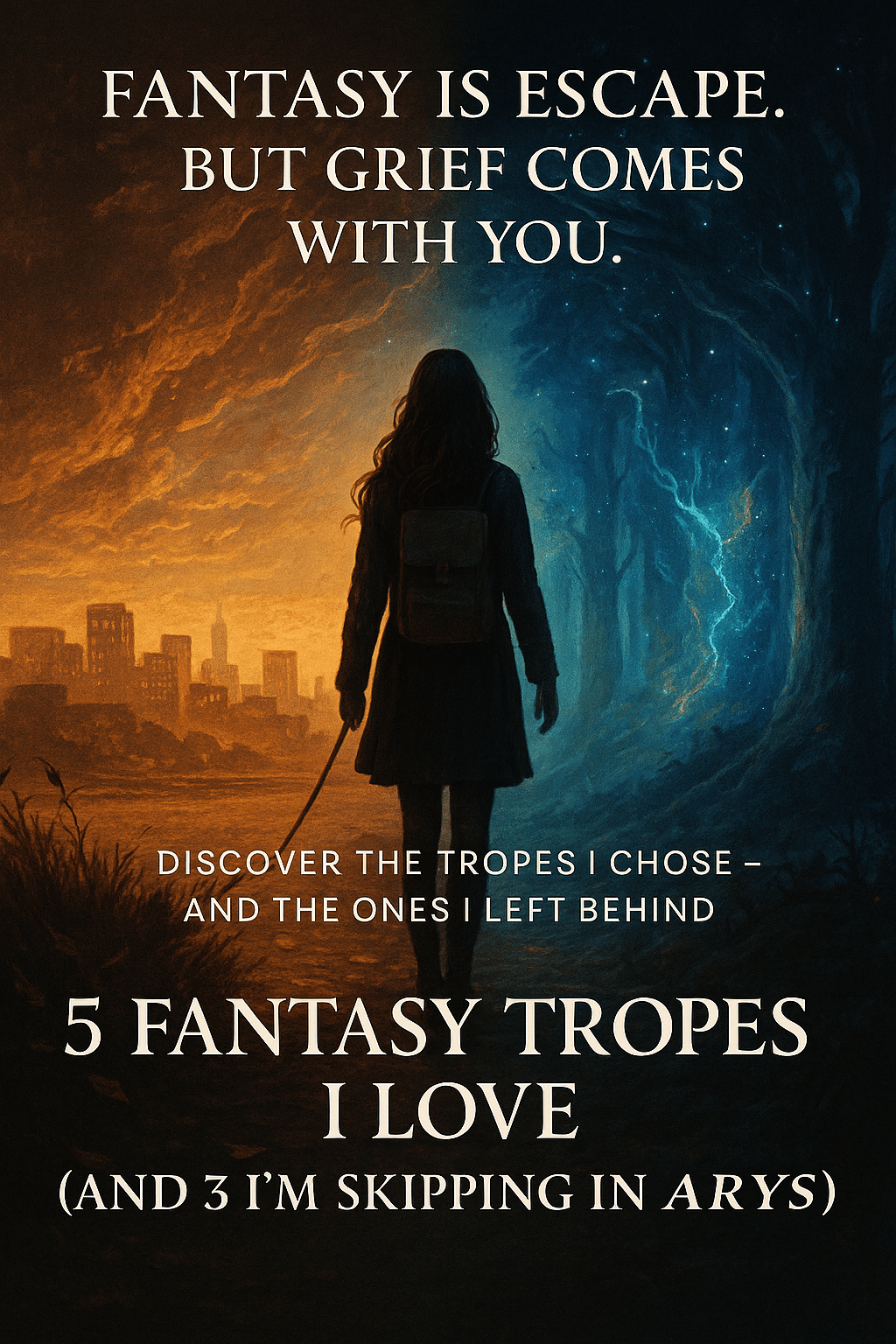
Those stories had something in common: they took us out of our world and into another. Magic, destiny, danger, and self-discovery collided on every page. But even as I adored them, I noticed a pattern that stuck with me especially once I grew up and understood more about trauma and grief: when the main character got whisked away into a new world, they barely blinked. The emotional gravity of leaving everything behind was rarely addressed. Now, we know that Harry was escaping his abusive aunt and uncle, but a normal human being would do more than think… “Wait. I’m a wizard?!” and just go with the flow.
Before we dive in — what’s a trope?
In simple terms, a trope is a storytelling pattern. A recurring idea, character type, or situation that we see again and again in fiction — like the “chosen one,” the “wise mentor,” or “magic has a price.” Some tropes are timeless, others feel overdone, but they all shape the way stories unfold.
Don’t get me wrong — Tropes aren’t the enemy — they’re tools. But tools only work if you use them with intention.
So when I sat down to write Arys, I knew I wanted to honor the genre I love while doing something different. Yes, Arys is a story about prophecy, rebellion, and a magical realm in peril—but it’s also about grief. About what it really means to lose your life as you know it. Our girl doesn’t just leap into destiny with a sword and a smirk. She hesitates. She questions everything. She grieves, not just the loss of her life, but what it meant to be human. She takes a while to process through to understand that the friends and family she had were gone. Never to be seen again. And it Hurts with a capital H. Then when she comes to realize she also lost her entire Elven family before she could remember them, that hits its own emotional chord. We see this grief in some instances in the books I mentioned, don’t get me wrong. Harry saw his family in the Mirror of Erised and again when his wand connected with Voldemort’s. Gemma Doyal lost her beloved mother and it was gut-wrenching when she had to watch her disappear again. I wanted to capture these emotions and really let Arys feel them. Viscerally. The brain spirals in the middle of the night that keep her up, we understand that anxiety is real for her.
Fantasy is often an escape—but Arys also holds a mirror up to what we leave behind when we run. And that’s what makes this story feel real.
So in Arys, I’m keeping the fantasy elements that raised me—but I’m reshaping them with a modern lens. Here are five tropes I genuinely love and chose to honor, and three I left behind because they didn’t serve the emotional truth I wanted this story to carry.
TROPE #1: The Lost Heir
Why We Love It: There’s something irresistible about the idea that you might be more than you seem. That you have a secret legacy, a hidden destiny. It’s wish fulfillment at its finest.
We see it all over fantasy: Harry Potter, orphaned and unwanted, learns he’s The Boy Who Lived. Aragorn, ranger of the North, is actually heir to the throne of Gondor. Eragon, a farm boy, is tied to an ancient legacy of Dragon Riders. And of course, Daenerys Targaryen rises from exile to claim a throne that was stolen from her family.
These stories are powerful because they tap into something deeply human: the desire to be chosen, to have purpose, to matter. But they also tend to skip over a critical truth: power and legacy come at a cost.
How Arys Uses It: Arys is the last surviving heir of the Elven monarchy, hidden away in the human world to keep her safe. But this isn’t a story where she throws on a crown and magically becomes ready to rule. She doesn’t want power. She doesn’t even know if she believes she deserves it. Her legacy is complicated—some people see her as a savior, others as a threat.
Like Aragorn, she has to grow into her role. Like Daenerys, she grapples with betrayal and pain. Like Harry, she’s haunted by the trauma of survival. But Arys’s journey is her own. It’s less about reclaiming a throne and more about asking whether a throne should even exist. Her arc isn’t about being chosen. It’s about choosing herself.
And that choice is everything.
TROPE #2: The Prophecy (With a Twist)
Why We Love It:
There’s a reason prophecies are everywhere in fantasy — they raise the stakes before the story even begins. The moment we hear there’s a chosen one, we lean in. It’s the promise of fate, of mystery, of something bigger pulling the strings. It’s powerful.
From Harry Potter’s “neither can live while the other survives,” to the foretold return of Aragorn as the King of Gondor, to Eragon’s entanglement with ancient predictions — prophecies set the tone and build the tension. Even The Matrixplayed with this: Neo was believed to be “The One” who would change everything, but the real power came not from the prophecy itself, but from Neo’s choice to believe in it — or not.
How Arys Uses It (and Subverts It):
The prophecy in Arys isn’t a glowing roadmap. It’s cryptic. Troubling. And maybe even dangerous. It hints that Arys could save the world—or destroy it. That she might be the storm or the calm.
It doesn’t comfort her — it haunts her. Instead of clarity, it creates chaos. The ambiguity gnaws at her sense of self. Is she meant to lead, to heal, to burn it all down?
Like Neo in The Matrix, Arys has to decide whether she believes the prophecy — or whether she’ll write a new story altogether. Her journey isn’t about fulfilling fate. It’s about questioning it. It’s about rejecting the idea that power is handed down by destiny, and instead forging her own truth.
The result is a heroine who walks the knife’s edge between destiny and self-determination — and who refuses to be defined by a prophecy she didn’t write.
TROPE #3: The Reluctant Heroine
Why We Love It:
There’s something deeply human about a hero who doesn’t want the job. The reluctant heroine forces us to ask: What kind of person becomes a leader? Not the one who craves power — but the one who resists it, questions it, fears it. And yet steps forward anyway.
We’ve seen shades of this in Katniss Everdeen, who never asked to be the face of a revolution. In Alanna of Trebond, who had to fight not just for power, but to even be seen as capable of wielding it. Even Frodo Baggins, in his quiet way, didn’t want to carry the Ring — but did it anyway because someone had to.
How Arys Uses It:
Arys doesn’t burst into Elnorsia ready to fight. She doesn’t dream of power, or magic, or glory. At first, she wants nothing more than to go back to her quiet human life — back to college, her dog, her friends, her sense of normal.
But she can’t.
She’s thrown into a world where people expect her to save them. To lead them. To live up to a prophecy she didn’t ask for. And all she feels is grief. Self-doubt. Anger. Exhaustion.
Arys is not fearless — she is terrified. But what makes her a heroine is that she feels everything and still chooses to keep going. Her strength isn’t in swordplay or clever one-liners. It’s in her ability to sit with the weight of what she’s lost… and still rise.
This is not a girl who was born ready. This is a girl who becomes who she needs to be — one painful, stubborn, courageous step at a time.
TROPE #4: Found Family
Why We Love It:
Found family hits different. It’s the trope that reminds us we don’t have to share blood to belong. It’s about survival, loyalty, chosen love. In fantasy — especially when the protagonist loses everything — the emergence of a new, deeply bonded family is often what makes the story unforgettable.
From Harry, Ron, and Hermione to the Fellowship of the Ring, from Katniss and her squad to Alanna and her close circle— we see it over and over: the most powerful alliances are the ones forged in hardship, not inheritance.
How Arys Uses It:
Arys loses everything. Her human world, her friends, her family — all gone in one life-shattering choice. She arrives in Elnorsia completely untethered, and for a long time, she stays that way. She doesn’t immediately trust. She doesn’t know who’s safe. And honestly? She’s not sure she wants to connect.
But slowly, painfully, a new family begins to take shape — not out of obligation, but out of shared purpose, vulnerability, and the kind of moments that break you open.
Areon becomes something more than her protector — a mirror to her fears and her hope. The Outcast Tribes embrace her not as royalty, but as one of their own. Even the most unlikely companions (you’ll meet them 😉) become essential threads in the tapestry of her survival.
This isn’t a story of being accepted because of who she was. It’s about being loved because of who she becomes.
Because sometimes, the family you choose is the one that saves you.
TROPE #5: Magic With Consequences
Why We Love It:
Let’s be real — magic is fun. But magic that costs something? That’s where it gets interesting.
The best fantasy doesn’t treat magic like a free superpower. Whether it drains energy, chips away at the soul, or comes with moral weight, we love when magic feels earned. It raises the stakes, deepens character arcs, and keeps the world grounded.
Think of Frodo and the toll of the Ring. Or Harry, learning that magic can’t solve grief, war, or loss. Or Daenerys, whose dragons give her power but also ignite devastation. When magic has weight, it means something.
How Arys Uses It:
In Arys, magic isn’t just something you do — it’s something you become. The system of Táravesta isn’t about spells and explosions. It’s about alignment with divine law. It requires discipline, emotional clarity, and an understanding of truth.
Unlike in Harry Potter, where magic often reveals itself through childhood outbursts, or A Great and Terrible Beauty, where Gemma is gifted power she can even share — Arys paints a different picture. Táravesta is accessible to anyone who is willing to commit to the work. It’s not hereditary or exclusive to the gifted. But that accessibility comes with a price: mastery takes time, mentorship, and inner alignment.
This means that in practice, magic tends to be concentrated among the upper classes — not because of blood, but because they have their basic needs met. They have the time, energy, and support systems to devote to a magical discipline that requires daily practice and mental clarity.
For Arys, learning Táravesta isn’t instinctive — it’s painstaking. It exhausts her, confuses her, and humbles her. The early results are inconsistent and draining. She doesn’t unlock powers with a flick of her wrist. She wrestles with doubt, burnout, and the deeper spiritual truths that magic demands.
Magic has consequences — physical, mental, emotional. But it also holds promise. Anyone can access it. But not everyone will do what it takes.
Táravesta is magic that demands growth. And Arys has to work for every ounce of it… — and who refuses to be defined by a prophecy she didn’t write.
3 Fantasy Tropes I’m Avoiding in Arys (and Why)
As much as I love fantasy, some tropes just don’t sit right with me anymore. Whether they feel outdated, overused, or emotionally shallow, these are the three tropes I deliberately left out of Arys — and what I chose to do instead.
TROPE I’M SKIPPING #1: The Love Triangle for Drama’s Sake
Why It Doesn’t Work for Me:
Love triangles can be fun — but too often, they’re used to manufacture tension instead of deepen it. We’ve all read the story where the protagonist has two impossibly hot love interests and spends three books flip-flopping between them, while the real emotional arc gets lost in the back-and-forth. It ends up feeling like a distraction from the real stakes — and from the deeper emotional journey that makes us care.
What Arys Does Instead:
There is a romance in Arys, and it simmers with tension — but it’s rooted in real emotional stakes, not a shallow “Team A or Team B” setup. The love story unfolds slowly, grounded in shared experiences, sacrifice, and the vulnerability that comes from surviving trauma together.
Areon, the male lead, is not a stock love interest. He’s lived a lifetime more than Arys — and that gap matters. He carries the weight of loss, duty, and mistakes made long before Arys entered his world. In many ways, he’s the opposite of the “ancient immortal falls for young heroine” trope, because Areon doesn’t seek her out romantically. He sees her as a responsibility at first — a girl he’s sworn to protect.
But slowly, painfully, that starts to change.
He watches Arys grow into her power, not because she’s chosen, but because she chooses herself. And what breaks him open is not her magic, or her title, or her destiny — it’s her honesty. Her stubbornness. Her empathy. He begins to see her not as a mission, but as a mirror. Someone who understands what it means to lose everything and still show up for others.
That shift doesn’t come easily. Areon fights it. He tells himself it’s too dangerous. That he’s too old. That he’s too broken. And Arys, for her part, has no intention of falling into a fairytale. What they build is complicated. Real. Rooted in a slow-burning trust that might never fully catch fire — or might burn the world down when it does.
So yes, there’s romance in Arys. But it’s not a triangle. It’s a quiet revolution.
TROPE I’M SKIPPING #2: Evil for Evil’s Sake
Why It Doesn’t Work for Me:
We’ve all read (or watched) the villain who just… wants to destroy everything. Or rule everything. Or hurt people just because. And sure, that kind of antagonist can be fun in certain stories. But in a world like Arys, where everything is built on grief, power, and legacy — “evil” has to be more than black and white.
A one-dimensional villain doesn’t scare me. What scares me is a villain who believes he’s right.
What Arys Does Instead:
Elborix, the antagonist in Arys, isn’t twirling a mustache behind a throne. He’s not out to destroy the world — he thinks he’s saving it. He was shaped by loss. He was betrayed. He clawed his way out of a system that told him he didn’t belong. And when the Elven world was on the brink of collapse, he made the ruthless decision to consolidate power — not out of cruelty, but out of fear.
He believes that unity requires control. That survival requires sacrifice. That compassion is weakness. And somewhere along the way, he lost sight of the line between protection and domination.
What makes him terrifying isn’t just his power — it’s his conviction.
And Arys doesn’t face him as some all-good chosen one bringing balance to the galaxy. She sees parts of herself in him. She understands his grief. She’s forced to confront the uncomfortable truth that the difference between them isn’t strength or magic — it’s the choices they make when everything feels impossible.
This isn’t a story about defeating evil. It’s a story about breaking cycles.
TROPE I’M SKIPPING #3: Instant Adaptation to the Magical World
Why It Doesn’t Work for Me:
In so many fantasy books, the protagonist gets ripped from their normal life, dropped into a magical world, and… adjusts instantly. Sure, they gasp at the dragons or glowing runes, but emotionally? They’re weirdly fine. Ready to train, ready to fight, rarely stopping to grieve the life they lost.
But here’s the thing: losing everything you’ve ever known — your family, your routines, your identity — would wreck most people. That kind of loss deserves space. And that kind of change doesn’t happen overnight.
What Arys Does Instead:
Arys doesn’t “bounce back.” She doesn’t learn magic in a week and declare herself ready to lead a rebellion. She leaves behind a real life — friends, college, the human world she thought was hers. And that loss cuts deep.
She misses her Mom. Her boyfriend and social circle. Her late-night snacks. The feeling of control, a career path she was cultivating, the feeling of anonymity, of being nobody. And she doesn’t stop missing those things just because magic exists. If anything, they haunt her more once they’re gone.
What makes it harder is that no one in Elnorsia really understands what she’s lost — not fully. She’s isolated. Unmoored. Even as she starts to understand her Elven heritage, she’s grieving the human one she never asked to give up.
Throughout the story, Arys revisits her grief. It comes in waves. It affects how she learns, how she connects, how she fights. Her emotional arc is just as important as her magical one — because she can’t become who she’s meant to be without first honoring who she was.
In Arys, stepping into a magical world isn’t just a plot device — it’s a trauma. And growth takes time.
For the Ones Who Want More from Their Magic
If you’ve ever finished a fantasy novel and thought, “I loved it… but I wish it had gone deeper,” — this book is for you.
Arys is a story shaped by the classics I grew up on — the ones that made me believe in other worlds. But it’s also built for this one. It honors the magic, the danger, the epic stakes — while refusing to skip over the heartbreak, the healing, and the quiet moments that change everything.
This is a story about power — and the choice to use it. About grief — and the courage to grow through it. About what we leave behind, and what we build from the ashes. And at the heart of it all is a girl who never wanted to be chosen — but chose herself anyway.
And don’t worry — Arys still brings the action, the danger, the rebellion, and the spark. There’s magic, battles, romance, and rebellion — just wrapped in emotional realism
If you’re looking for something familiar but unexpected… something thrilling but real… something magical but deeply human — Arys is waiting for you.
Are you ready to step into the storm? Join the journey—subscribe, follow, and be the first to witness what happens when power, prophecy, and soul collide.
🔗 Subscribe now and be first to meet the warrior who steps from the shadows — and changes everything.
💬 Share your thoughts: We want to hear from you! Leave a comment below.
📱 Follow us on Instagram or TikTok for more character spotlights, behind-the-scenes reveals, and upcoming release updates.

 E. Hope Grove
Leave a reply to duncansusan Cancel reply